AI Code Review Prompt

AI Code Review Prompt — independent reviews, comparisons, pricing and step-by-step guides on Aizhi.

  • Anomaly Detection at Multiple Scales

    Anomaly Detection at Multiple Scales

    Anomaly Detection at Multiple Scales, or ADAMS was a $35 million DARPA project designed to identify patterns and anomalies in very large data sets. It is under DARPA's Information Innovation office and began in 2011 and ended in August 2014 The project was intended to detect and prevent insider threats such as "a soldier in good mental health becoming homicidal or suicidal", an "innocent insider becoming malicious", or "a government employee [who] abuses access privileges to share classified information". Specific cases mentioned are Nadal Malik Hasan and WikiLeaks source Chelsea Manning. Commercial applications may include finance. The intended recipients of the system output are operators in the counterintelligence agencies. A final report was published on May 11, 2015, detailing a system known as Anomaly Detection Engine for Networks, or ADEN, developed by the University of Maryland, College Park, whose goal was to "identify malicious users within a network." Using multiple datasets from Wikipedia, Slashdot, and others, researchers were able to identify vandals and malicious users on a website using both conventional algorithms and artificial intelligence. The Proactive Discovery of Insider Threats Using Graph Analysis and Learning was part of the ADAMS project. The Georgia Tech team includes noted high-performance computing researcher David Bader (computer scientist).

    Read more →
  • Hierarchical navigable small world

    Hierarchical navigable small world

    Hierarchical navigable small world (HNSW) is an algorithm for approximate nearest neighbor search. It is used to find items that are similar to a query item in a large collection, without comparing the query with every item one by one. The algorithm is commonly used for searching vector data. In these systems, an item such as a document, image, song, or user profile is represented by a list of numbers called a vector. Items with similar vectors are treated as similar according to the model that produced the vectors. HNSW provides a way to search these vectors quickly, especially in large datasets. HNSW stores vectors in a graph. Each vector is a node, and links connect it to some nearby vectors. The graph has several layers: upper layers contain fewer nodes and act like a rough map, while the bottom layer contains all nodes and gives a more detailed view. A search starts in an upper layer, follows links toward nodes that are closer to the query, and then repeats the process in lower layers until it finds a set of likely nearest neighbors. == Background == The nearest neighbor search problem asks which items in a dataset are closest to a query item. A direct search can compare the query with every item in the dataset, but this becomes slow when the dataset is large. Exact search methods based on spatial trees, such as the k-d tree and R-tree, can also become less effective for high-dimensional data, a problem often associated with the curse of dimensionality. Approximate nearest neighbor methods trade some exactness for speed or lower resource use. Instead of always guaranteeing the exact closest item, they try to return close items quickly. Other approximate methods include locality-sensitive hashing and product quantization. HNSW builds on research into small-world networks and navigable graphs. In a small-world graph, most nodes can be reached from other nodes through a short chain of links. In a navigable graph, a search procedure can use local information to move toward a target. Jon Kleinberg's work on navigation in small-world networks is an important example of this research area. Later work studied ways to add links that make graphs easier to navigate greedily. The HNSW algorithm extends earlier navigable small world methods for similarity search by adding a hierarchy of graph layers. This hierarchy helps the algorithm find a good region of the graph before doing a more detailed search in the bottom layer. == Algorithm == HNSW is based on a proximity graph. In this graph, nearby vectors are connected by edges. The algorithm uses these edges to move through the dataset, rather than scanning every vector. The graph is hierarchical. Every vector appears in the bottom layer. Some vectors are also placed in higher layers, with fewer vectors appearing as the layers go upward. The upper layers allow long-range movement across the dataset, while the lower layers allow a more detailed search near promising candidates. A typical search proceeds as follows: The search begins from an entry point in the highest layer. At each step, the algorithm looks at neighboring nodes and moves to a neighbor that is closer to the query. When it cannot find a closer neighbor in that layer, it moves down to the next layer. In the bottom layer, it explores a wider set of candidate nodes and returns the nearest candidates found. This search strategy is often described as greedy navigation. The algorithm repeatedly chooses locally better nodes, using the graph structure to approach the query point. == Construction and parameters == The HNSW graph is built incrementally. When a new vector is inserted, the algorithm assigns it a maximum layer, searches for nearby existing nodes, and connects the new node to selected neighbors in each layer where it appears. Implementations usually expose parameters that control the trade-off between speed, accuracy, memory use, and construction time. A higher number of graph connections can improve recall but requires more memory. A larger search candidate list can improve accuracy but makes queries slower. A larger construction candidate list can improve the quality of the graph but makes index building slower. Because HNSW is approximate, its results are not always identical to a full exact search. Its practical performance depends on the dataset, distance measure, implementation, and parameter settings. Benchmarking studies have found HNSW-based libraries to be strong performers among approximate nearest neighbor methods, although worst-case performance can differ from performance on common benchmark datasets. == Use in vector search systems == HNSW is used as an index in systems that store and search high-dimensional vectors. These systems include vector databases, search engines, and database extensions. Typical uses include semantic search, recommender systems, image similarity search, and retrieval-augmented generation. Several software projects implement or support HNSW. Libraries include hnswlib, which is associated with the original HNSW authors, and FAISS. Database and search systems that document HNSW support include Apache Lucene, Chroma, ClickHouse, DuckDB, MariaDB, Milvus, pgvector, Qdrant, and Redis.

    Read more →
  • Structured sparsity regularization

    Structured sparsity regularization

    Structured sparsity regularization is a class of methods, and an area of research in statistical learning theory, that extend and generalize sparsity regularization learning methods. Both sparsity and structured sparsity regularization methods seek to exploit the assumption that the output variable Y {\displaystyle Y} (i.e., response, or dependent variable) to be learned can be described by a reduced number of variables in the input space X {\displaystyle X} (i.e., the domain, space of features or explanatory variables). Sparsity regularization methods focus on selecting the input variables that best describe the output. Structured sparsity regularization methods generalize and extend sparsity regularization methods, by allowing for optimal selection over structures like groups or networks of input variables in X {\displaystyle X} . Common motivation for the use of structured sparsity methods are model interpretability, high-dimensional learning (where dimensionality of X {\displaystyle X} may be higher than the number of observations n {\displaystyle n} ), and reduction of computational complexity. Moreover, structured sparsity methods allow to incorporate prior assumptions on the structure of the input variables, such as overlapping groups, non-overlapping groups, and acyclic graphs. Examples of uses of structured sparsity methods include face recognition, magnetic resonance image (MRI) processing, socio-linguistic analysis in natural language processing, and analysis of genetic expression in breast cancer. == Definition and related concepts == === Sparsity regularization === Consider the linear kernel regularized empirical risk minimization problem with a loss function V ( y i , f ( x ) ) {\displaystyle V(y_{i},f(x))} and the ℓ 0 {\displaystyle \ell _{0}} "norm" as the regularization penalty: min w ∈ R d 1 n ∑ i = 1 n V ( y i , ⟨ w , x i ⟩ ) + λ ‖ w ‖ 0 , {\displaystyle \min _{w\in \mathbb {R} ^{d}}{\frac {1}{n}}\sum _{i=1}^{n}V(y_{i},\langle w,x_{i}\rangle )+\lambda \|w\|_{0},} where x , w ∈ R d {\displaystyle x,w\in \mathbb {R^{d}} } , and ‖ w ‖ 0 {\displaystyle \|w\|_{0}} denotes the ℓ 0 {\displaystyle \ell _{0}} "norm", defined as the number of nonzero entries of the vector w {\displaystyle w} . f ( x ) = ⟨ w , x i ⟩ {\displaystyle f(x)=\langle w,x_{i}\rangle } is said to be sparse if ‖ w ‖ 0 = s < d {\displaystyle \|w\|_{0}=s 0 {\displaystyle w_{j}>0} . However, as in this case groups may overlap, we take the intersection of the complements of those groups that are not set to zero. This intersection of complements selection criteria implies the modeling choice that we allow some coefficients within a particular group g {\displaystyle g} to be set to zero, while others within the same group g {\displaystyle g} may remain positive. In other words, coefficients within a group may differ depending on the several group memberships that each variable within the group may have. ==== Union of groups: latent group Lasso ==== A different approach is to consider union of groups for variable selection. This approach captures the modeling situation where variables can be selected as long as they belong at least to one group with positive coefficients. This modeling perspective implies that we want to preserve group structure. The formulation of the union of groups approach is also referred to as latent group Lasso, and requires to modify the group ℓ 2 {\displaystyle \ell _{2}} norm considered above and introduce the following regularizer R ( w ) = i n f { ∑ g ‖ w g ‖ g : w = ∑ g = 1 G w ¯ g } {\displaystyle R(w)=inf\left\{\sum _{g}\|w_{g}\|_{g}:w=\sum _{g=1}^{G}{\bar {w}}_{g}\right\}} where w ∈ R d {\displaystyle w\in {\mathbb {R^{d}} }} , w g ∈ G g {\displaystyle w_{g}\in G_{g}} is the vector of coefficients of group g, and w ¯ g ∈ R d {\displaystyle {\bar {w}}_{g}\in {\mathbb {R^{d}} }} is a vector with coefficients w g j {\displaystyle w_{g}^{j}} for all variables j {

    Read more →
  • Organoid intelligence

    Organoid intelligence

    Organoid intelligence (OI) is an emerging field of study in computer science and biology that develops and studies biological wetware computing using 3D cultures of human brain cells (or brain organoids) and brain-machine interface technologies. Such technologies may be referred to as OIs or the nervous filesystem. Organoid intelligent computer systems can be an example of biohybrid systems. == Differences with non-organic computing == As opposed to traditional non-organic silicon-based approaches, OI seeks to use lab-grown cerebral organoids to serve as "biological hardware". While these structures are still far from being able to think like a regular human brain and do not yet possess strong computing capabilities, OI research currently offers the potential to improve the understanding of brain development, learning and memory, potentially finding treatments for neurological disorders such as dementia. Thomas Hartung, a professor from Johns Hopkins University, argued in 2023 that "while silicon-based computers are certainly better with numbers, brains are better at learning." He noted that transistor density in computer chip may be approaching its limits, whereas brains, being wired differently, are more energy-efficient and can store large amounts of information. Some researchers claim that even though human brains are slower than machines at processing simple information, they are far better at processing complex information as brains can deal with fewer and more uncertain data, perform both sequential and parallel processing, being highly heterogenous, use incomplete datasets, and is said to outperform non-organic machines in decision-making. Training OIs involve the process of biological learning (BL) as opposed to machine learning (ML) for AIs. == Bioinformatics in OI == OI generates complex biological data, necessitating sophisticated methods for processing and analysis. Bioinformatics provides the tools and techniques to decipher raw data, uncovering the patterns and insights. Researchers have developed a platform named Neuroplatform for experimenting remotely with brain organoids via an API. == Intended functions == Brain-inspired computing hardware aims to emulate the structure and working principles of the brain and could be used to address current limitations in AI technologies. However, brain-inspired silicon chips are still limited in their ability to fully mimic brain function, as most examples are built on digital electronic principles. One study performed OI computation (which they termed Brainoware) by sending and receiving information from the brain organoid using a high-density multielectrode array. By applying spatiotemporal electrical stimulation, nonlinear dynamics, and fading memory properties, as well as unsupervised learning from training data by reshaping the organoid functional connectivity, the study showed the potential of this technology by using it for speech recognition and nonlinear equation prediction in a reservoir computing framework. == Ethical concerns == While researchers are hoping to use OI and biological computing to complement traditional silicon-based computing, there are also questions about the ethics of such an approach. Concerns include the possibility that an organoid could develop sentience or consciousness, and the question of the relationship between a stem cell donor (for growing the organoid) and the respective OI system.

    Read more →
  • Learnable function class

    Learnable function class

    In statistical learning theory, a learnable function class is a set of functions for which an algorithm can be devised to asymptotically minimize the expected risk, uniformly over all probability distributions. The concept of learnable classes are closely related to regularization in machine learning, and provides large sample justifications for certain learning algorithms. == Definition == === Background === Let Ω = X × Y = { ( x , y ) } {\displaystyle \Omega ={\mathcal {X}}\times {\mathcal {Y}}=\{(x,y)\}} be the sample space, where y {\displaystyle y} are the labels and x {\displaystyle x} are the covariates (predictors). F = { f : X ↦ Y } {\displaystyle {\mathcal {F}}=\{f:{\mathcal {X}}\mapsto {\mathcal {Y}}\}} is a collection of mappings (functions) under consideration to link x {\displaystyle x} to y {\displaystyle y} . L : Y × Y ↦ R {\displaystyle L:{\mathcal {Y}}\times {\mathcal {Y}}\mapsto \mathbb {R} } is a pre-given loss function (usually non-negative). Given a probability distribution P ( x , y ) {\displaystyle P(x,y)} on Ω {\displaystyle \Omega } , define the expected risk I P ( f ) {\displaystyle I_{P}(f)} to be: I P ( f ) = ∫ L ( f ( x ) , y ) d P ( x , y ) {\displaystyle I_{P}(f)=\int L(f(x),y)dP(x,y)} The general goal in statistical learning is to find the function in F {\displaystyle {\mathcal {F}}} that minimizes the expected risk. That is, to find solutions to the following problem: f ^ = arg ⁡ min f ∈ F I P ( f ) {\displaystyle {\hat {f}}=\arg \min _{f\in {\mathcal {F}}}I_{P}(f)} But in practice the distribution P {\displaystyle P} is unknown, and any learning task can only be based on finite samples. Thus we seek instead to find an algorithm that asymptotically minimizes the empirical risk, i.e., to find a sequence of functions { f ^ n } n = 1 ∞ {\displaystyle \{{\hat {f}}_{n}\}_{n=1}^{\infty }} that satisfies lim n → ∞ P ( I P ( f ^ n ) − inf f ∈ F I P ( f ) > ϵ ) = 0 {\displaystyle \lim _{n\rightarrow \infty }\mathbb {P} (I_{P}({\hat {f}}_{n})-\inf _{f\in {\mathcal {F}}}I_{P}(f)>\epsilon )=0} One usual algorithm to find such a sequence is through empirical risk minimization. === Learnable function class === We can make the condition given in the above equation stronger by requiring that the convergence is uniform for all probability distributions. That is: The intuition behind the more strict requirement is as such: the rate at which sequence { f ^ n } {\displaystyle \{{\hat {f}}_{n}\}} converges to the minimizer of the expected risk can be very different for different P ( x , y ) {\displaystyle P(x,y)} . Because in real world the true distribution P {\displaystyle P} is always unknown, we would want to select a sequence that performs well under all cases. However, by the no free lunch theorem, such a sequence that satisfies (1) does not exist if F {\displaystyle {\mathcal {F}}} is too complex. This means we need to be careful and not allow too "many" functions in F {\displaystyle {\mathcal {F}}} if we want (1) to be a meaningful requirement. Specifically, function classes that ensure the existence of a sequence { f ^ n } {\displaystyle \{{\hat {f}}_{n}\}} that satisfies (1) are known as learnable classes. It is worth noting that at least for supervised classification and regression problems, if a function class is learnable, then the empirical risk minimization automatically satisfies (1). Thus in these settings not only do we know that the problem posed by (1) is solvable, we also immediately have an algorithm that gives the solution. == Interpretations == If the true relationship between y {\displaystyle y} and x {\displaystyle x} is y ∼ f ∗ ( x ) {\displaystyle y\sim f^{}(x)} , then by selecting the appropriate loss function, f ∗ {\displaystyle f^{}} can always be expressed as the minimizer of the expected loss across all possible functions. That is, f ∗ = arg ⁡ min f ∈ F ∗ I P ( f ) {\displaystyle f^{}=\arg \min _{f\in {\mathcal {F}}^{}}I_{P}(f)} Here we let F ∗ {\displaystyle {\mathcal {F}}^{}} be the collection of all possible functions mapping X {\displaystyle {\mathcal {X}}} onto Y {\displaystyle {\mathcal {Y}}} . f ∗ {\displaystyle f^{}} can be interpreted as the actual data generating mechanism. However, the no free lunch theorem tells us that in practice, with finite samples we cannot hope to search for the expected risk minimizer over F ∗ {\displaystyle {\mathcal {F}}^{}} . Thus we often consider a subset of F ∗ {\displaystyle {\mathcal {F}}^{}} , F {\displaystyle {\mathcal {F}}} , to carry out searches on. By doing so, we risk that f ∗ {\displaystyle f^{}} might not be an element of F {\displaystyle {\mathcal {F}}} . This tradeoff can be mathematically expressed as In the above decomposition, part ( b ) {\displaystyle (b)} does not depend on the data and is non-stochastic. It describes how far away our assumptions ( F {\displaystyle {\mathcal {F}}} ) are from the truth ( F ∗ {\displaystyle {\mathcal {F}}^{}} ). ( b ) {\displaystyle (b)} will be strictly greater than 0 if we make assumptions that are too strong ( F {\displaystyle {\mathcal {F}}} too small). On the other hand, failing to put enough restrictions on F {\displaystyle {\mathcal {F}}} will cause it to be not learnable, and part ( a ) {\displaystyle (a)} will not stochastically converge to 0. This is the well-known overfitting problem in statistics and machine learning literature. == Example: Tikhonov regularization == A good example where learnable classes are used is the so-called Tikhonov regularization in reproducing kernel Hilbert space (RKHS). Specifically, let F ∗ {\displaystyle {\mathcal {F^{}}}} be an RKHS, and | | ⋅ | | 2 {\displaystyle ||\cdot ||_{2}} be the norm on F ∗ {\displaystyle {\mathcal {F^{}}}} given by its inner product. It is shown in that F = { f : | | f | | 2 ≤ γ } {\displaystyle {\mathcal {F}}=\{f:||f||_{2}\leq \gamma \}} is a learnable class for any finite, positive γ {\displaystyle \gamma } . The empirical minimization algorithm to the dual form of this problem is arg ⁡ min f ∈ F ∗ { ∑ i = 1 n L ( f ( x i ) , y i ) + λ | | f | | 2 } {\displaystyle \arg \min _{f\in {\mathcal {F}}^{}}\left\{\sum _{i=1}^{n}L(f(x_{i}),y_{i})+\lambda ||f||_{2}\right\}} This was first introduced by Tikhonov to solve ill-posed problems. Many statistical learning algorithms can be expressed in such a form (for example, the well-known ridge regression). The tradeoff between ( a ) {\displaystyle (a)} and ( b ) {\displaystyle (b)} in (2) is geometrically more intuitive with Tikhonov regularization in RKHS. We can consider a sequence of { F γ } {\displaystyle \{{\mathcal {F}}_{\gamma }\}} , which are essentially balls in F ∗ {\displaystyle {\mathcal {F^{}}}} with centers at 0. As γ {\displaystyle \gamma } gets larger, F γ {\displaystyle {\mathcal {F}}_{\gamma }} gets closer to the entire space, and ( b ) {\displaystyle (b)} is likely to become smaller. However we will also suffer smaller convergence rates in ( a ) {\displaystyle (a)} . The way to choose an optimal γ {\displaystyle \gamma } in finite sample settings is usually through cross-validation. == Relationship to empirical process theory == Part ( a ) {\displaystyle (a)} in (2) is closely linked to empirical process theory in statistics, where the empirical risk { ∑ i = 1 n L ( y i , f ( x i ) ) , f ∈ F } {\displaystyle \{\sum _{i=1}^{n}L(y_{i},f(x_{i})),f\in {\mathcal {F}}\}} are known as empirical processes. In this field, the function class F {\displaystyle {\mathcal {F}}} that satisfies the stochastic convergence are known as uniform Glivenko–Cantelli classes. It has been shown that under certain regularity conditions, learnable classes and uniformly Glivenko-Cantelli classes are equivalent. Interplay between ( a ) {\displaystyle (a)} and ( b ) {\displaystyle (b)} in statistics literature is often known as the bias-variance tradeoff. However, note that in the authors gave an example of stochastic convex optimization for General Setting of Learning where learnability is not equivalent with uniform convergence.

    Read more →
  • Intelligent database

    Intelligent database

    Until the 1980s, databases were viewed as computer systems that stored record-oriented and business data such as manufacturing inventories, bank records, and sales transactions. A database system was not expected to merge numeric data with text, images, or multimedia information, nor was it expected to automatically notice patterns in the data it stored. In the late 1980s the concept of an intelligent database was put forward as a system that manages information (rather than data) in a way that appears natural to users and which goes beyond simple record keeping. The term was introduced in 1989 by the book Intelligent Databases by Kamran Parsaye, Mark Chignell, Setrag Khoshafian and Harry Wong. The concept postulated three levels of intelligence for such systems: high level tools, the user interface and the database engine. The high level tools manage data quality and automatically discover relevant patterns in the data with a process called data mining. This layer often relies on the use of artificial intelligence techniques. The user interface uses hypermedia in a form that uniformly manages text, images and numeric data. The intelligent database engine supports the other two layers, often merging relational database techniques with object orientation. In the twenty-first century, intelligent databases have now become widespread, e.g. hospital databases can now call up patient histories consisting of charts, text and x-ray images just with a few mouse clicks, and many corporate databases include decision support tools based on sales pattern analysis.

    Read more →
  • H (company)

    H (company)

    H Company, also known simply as H, is a French artificial intelligence startup which develops "action-oriented" artificial intelligence agents for enterprise automation and productivity. In May 2024, H Company closed a record-setting $220 million seed round, at the time the largest AI raise in Europe. In 2026, H Company released Holo 3, the latest generation of its computer-use AI models. The update marked a major advance in agentic AI, enabling agents to navigate any user interface, interpret screens, and complete complex, multi-step tasks across enterprise systems—much like a human user. This breakthrough positioned H Company at the frontier of computer-use autonomy, accelerating the integration of AI in enterprise workflows. == History == H Company was founded in 2023 in Paris by Laurent Sifre, Charles Kantor, and three DeepMind veterans: Daan Wiestra, Karl Tuyls, Julien Perollat. In May 2024, the firm secured what was then the largest European AI seed round, totaling $220 million led by US investors including Eric Schmidt (former Google CEO), Amazon, and backed by Accel, Bpifrance, UiPath, Eurazeo, Xavier Niel, Yuri Milner, Bernard Arnault, Samsung and others. In August 2024, three cofounders (Wiestra, Tuyls, Perollat) left the company over operational disagreements. In November 2024, H launched Runner H, its first agentic-API platform, which combined a large language model (LLM) and a reduced, 2-billion parameter vision-language model (VLM). In May 2025, H Company acquired Mithril Security, and in June 2025 the company widened its offering for agentic models. In June 2025, Gautier Cloix (formerly CEO Palantir France) replaced Charles Kantor as CEO of H Company, aiming to pivot the company towards a "forward deployed engineers" model. In July 2025, H Company introduced Surfer-H-CLI, an open-source, web-native Chrome agent designed for browser-based automation—able to search, scroll, click, and type on behalf of users and controllable via any visual language model (VLM). When paired with its June 2025 open-sourced 3B-parameter Holo-1 model, Surfer-H-CLI achieved 92.2% WebVoyager benchmark accuracy. == Activity == H Company creates enterprise AI models and agents (agentic AI) to automate and optimize complex workflows. H Company specifically designs AI agents called computer use capable of autonomously interfacing with any software (local or cloud-based) to detect and automate repetitive operations. H Company is based in Paris, France, with international offices in London and New York. H Company raised $220 million since its inception. Gautier Cloix is president and CEO of the company. H Company client include the French national lottery FDJ United. In March 2026, H Company released Holo3, a family of artificial intelligence models designed to operate digital systems by interacting directly with user interfaces. Holo3 enables agents ("virtual humanoids") to understand what is displayed in front-end environments—such as web pages, desktop applications, and other graphical user interfaces—and perform actions such as clicking, typing, and navigating across them to complete multi-step tasks. On the OSWorld-Verified benchmark, Holo3 reportedly achieved about 78.9%, surpassing the scores of OpenAI’s GPT‑5.4 and Anthropic’s Claude Opus 4.6 on this specific test, at roughly one-tenth of the inference cost of these proprietary systems. The release has been presented as a significant step toward automating routine digital workflows, allowing organizations to offload repetitive on-screen work, such as data entry and reconciliation across multiple tools, to AI-based agents.

    Read more →
  • Outline of deep learning

    Outline of deep learning

    The following outline is provided as an overview of, and topical guide to, deep learning: Deep learning is a subfield of machine learning and artificial intelligence based on artificial neural networks with multiple processing layers. It emphasizes representation learning and is widely used in areas such as computer vision, natural language processing, speech recognition, recommender systems, robotics, and generative artificial intelligence. == Ways to categorize deep learning == A field of study A branch of artificial intelligence A subfield of machine learning A subfield of computer science A form of representation learning A class of methods based on artificial neural networks An approach used in computational statistics == History == === Precursors === Cybernetics Perceptron Connectionism Neocognitron Backpropagation === Milestones === LeNet Long short-term memory Deep belief network AlexNet Sequence to sequence learning Generative adversarial network Residual neural network Transformer BERT Generative pre-trained transformer Diffusion model === Related histories === History of artificial intelligence History of machine learning Timeline of machine learning == Core concepts == == Learning settings == Supervised learning Unsupervised learning Self-supervised learning Semi-supervised learning Reinforcement learning Transfer learning Multitask learning Multimodal learning Online machine learning Continual learning == Common tasks == Image classification Object detection Image segmentation Automatic speech recognition Neural machine translation Question answering Automatic summarization Text-to-image model Protein structure prediction == Architectures == === Feedforward and convolutional architectures === Feedforward neural network Multilayer perceptron Convolutional neural network Radial basis function network Residual neural network U-Net === Recurrent and sequence architectures === Recurrent neural network Long short-term memory Gated recurrent unit Sequence to sequence learning Recursive neural network === Representation-learning architectures === Autoencoder Denoising autoencoder Sparse autoencoder Variational autoencoder Restricted Boltzmann machine Deep belief network === Attention and transformer architectures === Attention (machine learning) Transformer BERT Generative pre-trained transformer Vision transformer === Generative and probabilistic architectures === Autoregressive model Diffusion model Energy-based model Generative adversarial network Mixture of experts === Graph and memory architectures === Graph neural network Graph convolutional network Siamese network Neural Turing machine Memory network Echo state network Capsule neural network == Neural network components and techniques == Artificial neuron Activation function Rectified linear unit Sigmoid function Softmax function Embedding Convolution Pooling layer Attention Batch normalization Layer normalization Residual connections == Training and optimization == Backpropagation Gradient descent Stochastic gradient descent Adam optimization Learning rate Loss function Cross-entropy Mean squared error Regularization Dropout Early stopping Batch normalization Data augmentation Transfer learning Knowledge distillation Ensemble learning Curriculum learning == Datasets and benchmarks == CIFAR-10 ImageNet MNIST database Common Objects in Context (COCO) General Language Understanding Evaluation (GLUE) benchmark LibriSpeech SQuAD == Applications == === Computer vision === Computer vision Facial recognition system Image classification Image segmentation Medical imaging Object detection Optical character recognition === Natural language processing === Automatic summarization Chatbot Information retrieval Large language model Natural language processing Neural machine translation Question answering Sentiment analysis === Speech and audio === Automatic speech recognition Music information retrieval Speaker recognition Speech synthesis === Science and medicine === Bioinformatics Computational biology Drug discovery Medical diagnosis Protein structure prediction === Robotics and control === Autonomous car Computer game bot Control theory Robotics === Recommendation, search, and forecasting === Anomaly detection Forecasting Fraud detection Recommender system Search engine === Generative artificial intelligence === Deepfake Generative artificial intelligence Large language model Speech synthesis Text-to-image model === Computer graphics and video games === Deep Learning Anti-Aliasing (DLAA) Deep Learning Super Sampling (DLSS) == Hardware == AMD Instinct AMD XDNA Application-specific integrated circuit Deep learning processor, Neural processing unit (NPU), or Neural Engine Field-programmable gate array General-purpose computing on graphics processing units (GPGPU) Graphics processing unit NVIDIA Deep Learning Accelerator (NVDLA) Tensor processing unit Vision processing unit Wafer-scale integration === Supporting software platforms === CUDA Metal ROCm == Software == === Open-source frameworks and libraries === === Neural network software === EDLUT Emergent Encog JOONE Neuroph NeuroSolutions OpenNN Peltarion Synapse SNNS === Platforms, tools, and deployment === Amazon SageMaker Google Colab Hugging Face Kaggle Kubeflow MLflow ONNX OpenVINO TensorFlow Hub == Algorithms for deep learning and neural networks == Backpropagation Conjugate gradient method Generalized Hebbian algorithm Gradient descent Levenberg–Marquardt algorithm Perceptron Quasi-Newton method Wake-sleep algorithm == Methods and related topics == === Representation and metric learning === Contrastive learning Embedding Feature learning Manifold learning Metric learning === Generative modeling === Autoregressive model Diffusion model Generative adversarial network Generative model Variational inference === Efficient and scalable deep learning === Knowledge distillation Low-rank approximation Mixture of experts Quantization Sparsity === Reliability, safety, and interpretability === Adversarial machine learning AI alignment Algorithmic bias Catastrophic forgetting Differential privacy Explainable artificial intelligence Federated learning Hallucination (artificial intelligence) == Conferences and workshops == Annual Meeting of the Association for Computational Linguistics Conference on Computer Vision and Pattern Recognition Conference on Neural Information Processing Systems International Conference on Computer Vision International Conference on Learning Representations International Conference on Machine Learning == Organizations == === Research laboratories and institutions === Allen Institute for AI Alberta Machine Intelligence Institute European Laboratory for Learning and Intelligent Systems Google DeepMind Meta AI Mila Microsoft Research Vector Institute === Companies === Anthropic Cerebras Cohere DeepSeek Mistral AI OpenAI Stability AI xAI == Publications == === Books === Deep Learning – Ian Goodfellow and Yoshua Bengio Neural Networks and Deep Learning – Michael Nielsen Perceptrons – Marvin Minsky and Seymour Papert === Journals === IEEE Transactions on Neural Networks and Learning Systems Neural Networks Neural Computation == Influential persons ==

    Read more →
  • Touch 'n Go eWallet

    Touch 'n Go eWallet

    Touch 'n Go eWallet is a Malaysian digital wallet and online payment platform, established in Kuala Lumpur, Malaysia, in July 2017 as a joint venture between Touch 'n Go and Ant Financial. It allows users to make payments at over 280,000 merchant touch points via QR code, as well as perform peer-to-peer (P2P) money transfers. Since then, the e-wallet further diversified for users to pay for tolls via RFID or PayDirect, street parking and various online payment spanning e-hailing, car-sharing apps or taxis, various overhead bills; top-up for mobile prepaid or in-game currencies; purchases on e-commerce websites; food delivery; renewing motor insurance and other insurance/takaful plans; and even movie, bus, trains or airline tickets. == Background == Prior to the launch of the e-wallet service, Touch 'n Go provided stored-value physical all-in-one contactless card (namely Touch 'n Go cards or "TnG cards") that users can use to pay for toll fares, public transportation and parking lots as well as purchases in some retail stores. In 1999, Touch 'n Go also markets SmartTag devices that allow road users to pass through certain toll booths without the need to unwind the car window. The high entry cost of the device (around RM 100 each) also meant that only few can enjoy the seamless experience. In 2009, Touch 'n Go partnered with Maxis to launch FastTap, a new mobile payment service that utilised Near-Field Communication (NFC). Maxis customers can make payments by placing the phone near the card readers (that also supports physical bank cards and Touch ’N Go cards). However, the venture featured only one phone model, Nokia 6212, which greatly limited the public reach. In July 2012, Touch 'n Go announced another collaboration with CIMB and Maxis to create similar NFC-based online transaction service that runs on compatible smartphones. Touch 'n Go Wallet was launched in February 2017 as an QR code-based e-wallet application, to compete with Samsung Pay that utilizes NFC modules. In the controlled pilot test in Taman Tun Dr Ismail, the correspondents can experience basic functionalities (prepaid mobile service reload, bills payment, movie tickets and flight tickets purchase, transfer of money with another user, and payments at participating stores and restaurants). While the deployed version of the app was generally well-received, the existing process to transfer the balance to the physical TnG card stored value from the app garnered unanimous backlash. Test groups felt that the need to head to a self-service terminal named "Pick Up Device" in person within 24 hours for completion, along with the failure to do so (the balance would be credited back to the wallet after 24 hours), was not divulged clearly and also defeated the purpose of convenience, not to mention there were only 2 such terminals. The feature was eventually suspended. On 15 November 2017, Touch 'n Go was granted permission by the Central Bank of Malaysia to form a joint venture with Ant Financial, a Chinese-based financial company that operates Alipay. The partnership allowed the local e-wallet to learn from and build upon the operational model pioneered by Alipay. In June 2018, it was reported that Touch 'n Go was pilot testing the uses of the Touch 'n Go eWallet in Rapid Transit, as the ticketing system was enabled on the Kelana Jaya line in the Klang Valley. Pilot testing only applied to stations in Kelana Jaya, KL Gateway–Universiti, Kerinchi, KL Sentral, Dang Wangi, KLCC, and Ampang Park. The test was reported to be successful in February 2020 and was planned to be fully deployed on the LRT and MRT. Due to unforeseen circumstances, this feature did not come into fruition, the app merely adds in-app purchase of monthly concession cards called "My50". In August 2018, Touch 'n Go announced that selected drivers may experience first-hand a new RFID-based payment (later rebranded as "myRFID") that serves to replace SmartTag devices on closed toll roads with during pilot testing phase commencing on 3 September 2018. On 2 November 2018, participation in the ongoing pilot programme was expanded, allowing more drivers to sign up ahead of the public rollout of the RFID system. During the same period, Touch 'n Go has discontinued the sales of SmartTAG devices in favor of the RFID-based payment system. Initially, the installation of the RFID chip onto the car could only be done by Touch 'n Go staff at the RFID fitment centers, at no cost. As the pilot testing concluded on 15 February 2020, a self-installation kit are being offered to the public on Lazada and Shopee. Support for taxi-hailing mobile apps was added in November 2018 when Touch 'n Go partnered with EzCab and Public Cab, allowing users to make payments via QR code. This was later expanded to support MULA on 7 January 2020, and later MyCar on 4 April 2020. Touch 'n Go eWallet was also the first eWallet to convert Kuala Lumpur's most famous Ramadan bazaar in Kampong Bahru into "Kampong Kashless", a venue that can accept cashless QR payments. It welcomed more than 250,000 Malaysians including local celebrities and government officials. On 1 October 2019, some e-commerce websites owned by the Alibaba Group (TMall and Taobao) began to support Touch 'n Go eWallet payments, Lazada joined the list on 29 October 2019. Touch 'n Go eWallet was one of the three e-wallet services in Malaysia (the other being Boost and GrabPay) that was eligible for its users to receive an RM 30 credit in conjunction of E-Tunai Rakyat program under the Budget 2020 plan, that further normalizes adoption of cashless and mobile payment among Malaysians. Unlike Boost and GrabPay, whose P2P transfers were completely disabled until users have exhausted the RM 30 first, Touch 'n Go eWallet did not impose such measures. in 2020, Touch 'n Go eWallet joined DuitNow, an electronic transaction ecosystem in Malaysia which allows the funds from Touch 'n Go eWallet to be transferred to other competing services and vice versa, by implementing a standard DuitNow QR code deisgn. Japan become the first country outside Malaysia to support Touch 'n Go eWallet payment via Alipay Connect. During the COVID-19 pandemic and the enforcement of the movement control order, use of eWallets (including Touch 'n Go eWallet) increased tremendously among citizens due to its contactless nature of the payment and increased take-out orders at home; which in turn helped small and medium-sized enterprises to thrive. Touch 'n Go eWallet launched its loyalty programme – The Goal Hunter – in October 2020 where on monthly basis, users collect stamps by paying with the app in exchange for rewards that include lucky draws and other vouchers. == Services == Touch 'n Go eWallet app is available for download on both Google Play and Apple Appstore. It utilizes QR code technology for local in-store payments. The Touch 'n Go eWallet app also diversifies payment types, including but not limited to Utility bills Purchase of motor insurance policy Pay Later facility Prepaid reload and Postpaid payment to telecommunications companies loan repayments for courts, MBSJ payments, zakat and PTPTN payment for car parking P2P transfer airline ticket bookings; movie tickets from TGV Cinemas RFID refuelling at Shell stations (defunct after Shell launched its own payment app in 2024) User can reload the eWallet credit by setting up auto-reload, purchasing reload pins from convenience stores (such as 7-Eleven, KK Super Mart, MyNews, Family Mart etc.), reloading by FPX and credit/debit card. The PayDirect feature allows users to link their physical Touch 'n Go cards into the eWallet, where the toll fare can be debited from the eWallet balance when flashing the card near the sensor. In the circumstance of insufficient balance in the app, the toll fare will be deducted from the physical card's balance instead. This also conveniently allows users to view the card's remaining balance. Touch 'n Go eWallet is the first and only eWallet to offer a money-back guarantee when an unauthorised transaction is made on the user’s eWallet account, subject to Terms & Conditions. Payment via QR code scanning, including Touch 'n Go eWallet, becomes a norm in most of the shops/restaurants across Malaysia, including roadside hawkers/stall owners and automatic vending machines. The merchants usually display their owner's individual QR or Business account that they can apply for in-app. The popularity attributes to the low merchant onboarding cost (Unlike NFC payment and debit/credit card that requires purchase or rental of a payment terminal device at a yearly fee.) The app is also one of the few ewallet that supports bidirectional liquidity (alongside MAE developed by Maybank), where funds can be transferred two-way with bank accounts. This is not possible with the other major ewallets (GrabPay, Boost, ShopeePay etc.) where the money that is reloaded to the wallet cannot be transferred to another bank account, unless through manual req

    Read more →
  • Apprenticeship learning

    Apprenticeship learning

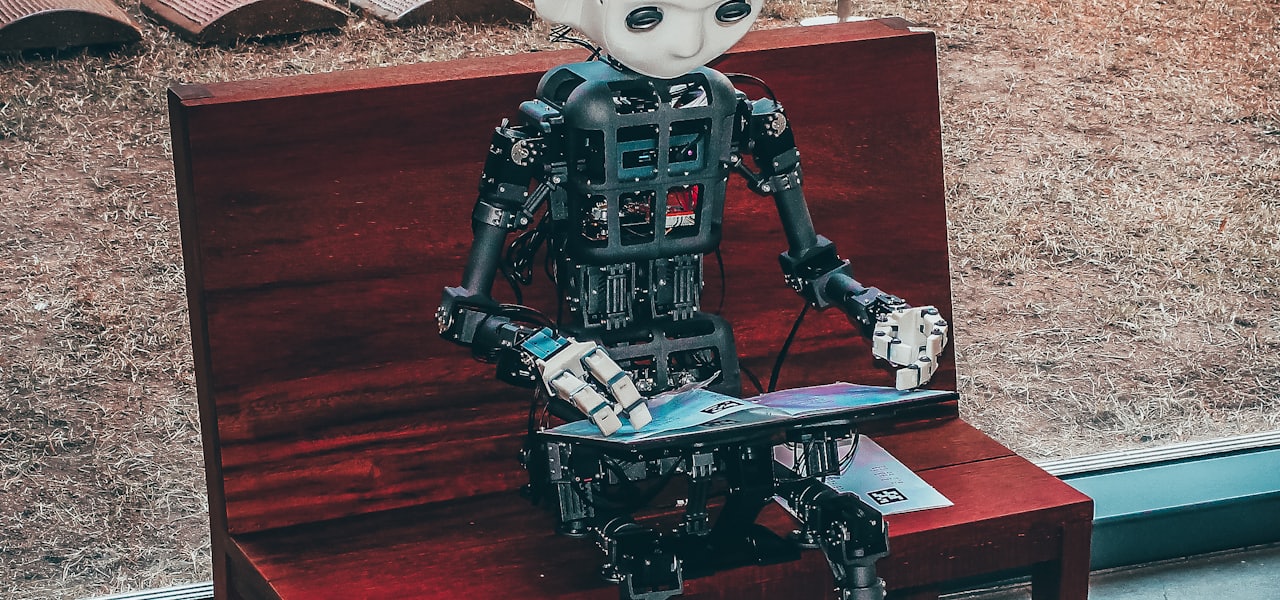
    In artificial intelligence, apprenticeship learning (or learning from demonstration or imitation learning) is the process of learning by observing an expert. It can be viewed as a form of supervised learning, where the training dataset consists of task executions by a demonstration teacher. == Mapping function approach == Mapping methods try to mimic the expert by forming a direct mapping either from states to actions, or from states to reward values. For example, in 2002 researchers used such an approach to teach an AIBO robot basic soccer skills. === Inverse reinforcement learning approach === Inverse reinforcement learning (IRL) is the process of deriving a reward function from observed behavior. While ordinary "reinforcement learning" involves using rewards and punishments to learn behavior, in IRL the direction is reversed, and a robot observes a person's behavior to figure out what goal that behavior seems to be trying to achieve. The IRL problem can be defined as: Given 1) measurements of an agent's behaviour over time, in a variety of circumstances; 2) measurements of the sensory inputs to that agent; 3) a model of the physical environment (including the agent's body): Determine the reward function that the agent is optimizing. IRL researcher Stuart J. Russell proposes that IRL might be used to observe humans and attempt to codify their complex "ethical values", in an effort to create "ethical robots" that might someday know "not to cook your cat" without needing to be explicitly told. The scenario can be modeled as a "cooperative inverse reinforcement learning game", where a "person" player and a "robot" player cooperate to secure the person's implicit goals, despite these goals not being explicitly known by either the person nor the robot. In 2017, OpenAI and DeepMind applied deep learning to the cooperative inverse reinforcement learning in simple domains such as Atari games and straightforward robot tasks such as backflips. The human role was limited to answering queries from the robot as to which of two different actions were preferred. The researchers found evidence that the techniques may be economically scalable to modern systems. Apprenticeship via inverse reinforcement learning (AIRP) was developed by in 2004 Pieter Abbeel, Professor in Berkeley's EECS department, and Andrew Ng, Associate Professor in Stanford University's Computer Science Department. AIRP deals with "Markov decision process where we are not explicitly given a reward function, but where instead we can observe an expert demonstrating the task that we want to learn to perform". AIRP has been used to model reward functions of highly dynamic scenarios where there is no obvious reward function intuitively. Take the task of driving for example, there are many different objectives working simultaneously - such as maintaining safe following distance, a good speed, not changing lanes too often, etc. This task, may seem easy at first glance, but a trivial reward function may not converge to the policy wanted. One domain where AIRP has been used extensively is helicopter control. While simple trajectories can be intuitively derived, complicated tasks like aerobatics for shows has been successful. These include aerobatic maneuvers like - in-place flips, in-place rolls, loops, hurricanes and even auto-rotation landings. This work was developed by Pieter Abbeel, Adam Coates, and Andrew Ng - "Autonomous Helicopter Aerobatics through Apprenticeship Learning" === System model approach === System models try to mimic the expert by modeling world dynamics. == Plan approach == The system learns rules to associate preconditions and postconditions with each action. In one 1994 demonstration, a humanoid learns a generalized plan from only two demonstrations of a repetitive ball collection task. == Example == Learning from demonstration is often explained from a perspective that the working Robot-control-system is available and the human-demonstrator is using it. And indeed, if the software works, the Human operator takes the robot-arm, makes a move with it, and the robot will reproduce the action later. For example, he teaches the robot-arm how to put a cup under a coffeemaker and press the start-button. In the replay phase, the robot is imitating this behavior 1:1. But that is not how the system works internally; it is only what the audience can observe. In reality, Learning from demonstration is much more complex. One of the first works on learning by robot apprentices (anthropomorphic robots learning by imitation) was Adrian Stoica's PhD thesis in 1995. In 1997, robotics expert Stefan Schaal was working on the Sarcos robot-arm. The goal was simple: solve the pendulum swingup task. The robot itself can execute a movement, and as a result, the pendulum is moving. The problem is, that it is unclear what actions will result into which movement. It is an Optimal control-problem which can be described with mathematical formulas but is hard to solve. The idea from Schaal was, not to use a Brute-force solver but record the movements of a human-demonstration. The angle of the pendulum is logged over three seconds at the y-axis. This results into a diagram which produces a pattern. In computer animation, the principle is called spline animation. That means, on the x-axis the time is given, for example 0.5 seconds, 1.0 seconds, 1.5 seconds, while on the y-axis is the variable given. In most cases it's the position of an object. In the inverted pendulum it is the angle. The overall task consists of two parts: recording the angle over time and reproducing the recorded motion. The reproducing step is surprisingly simple. As an input we know, in which time step which angle the pendulum must have. Bringing the system to a state is called “Tracking control” or PID control. That means, we have a trajectory over time, and must find control actions to map the system to this trajectory. Other authors call the principle “steering behavior”, because the aim is to bring a robot to a given line.

    Read more →
  • Representation collapse

    Representation collapse

    Representation collapse is a phenomenon in machine learning and representation learning where a model maps different inputs to the same or very similar embeddings, which means it loses important information about how the data is spread out. It is frequently encountered in self-supervised learning, especially within contrastive and non-contrastive frameworks, when training objectives or model architectures do not maintain variance across representations. Collapse results in degenerate solutions characterized by uninformative learned features, significantly impairing downstream task performance. Various techniques have been proposed to mitigate representation collapse, including the use of negative samples, architectural asymmetry, stop-gradient operations, variance regularization, and redundancy reduction objectives, as seen in methods such as SimCLR, BYOL, and VICReg. Comprehending and averting representation collapse is regarded as a fundamental challenge in the advancement of stable and efficient self-supervised learning systems.

    Read more →
  • Decision list

    Decision list

    Decision lists are a representation for Boolean functions which can be easily learned from examples. Single term decision lists are more expressive than disjunctions and conjunctions; however, 1-term decision lists are less expressive than the general disjunctive normal form and the conjunctive normal form. The language specified by a k-length decision list includes as a subset the language specified by a k-depth decision tree. Learning decision lists can be used for attribute efficient learning, a type of machine learning. == Definition == A decision list (DL) of length r is of the form: if f1 then output b1 else if f2 then output b2 ... else if fr then output br where fi is the ith formula and bi is the ith boolean for i ∈ { 1... r } {\displaystyle i\in \{1...r\}} . The last if-then-else is the default case, which means formula fr is always equal to true. A k-DL is a decision list where all of formulas have at most k terms. Sometimes "decision list" is used to refer to a 1-DL, where all of the formulas are either a variable or its negation.

    Read more →
  • Stixel

    Stixel

    In computer vision, a stixel (portmanteau of "stick" and "pixel") is a superpixel representation of depth information in an image, in the form of a vertical stick that approximates the closest obstacles within a certain vertical slice of the scene. Introduced in 2009, stixels have applications in robotic navigation and advanced driver-assistance systems, where they can be used to define a representation of robotic environments and traffic scenes with a medium level of abstraction. == Definition == One of the problems of scene understanding in computer vision is to determine horizontal freespace around the camera, where the agent can move, and the vertical obstacles delimiting it. An image can be paired with depth information (produced e.g. from stereo disparity, lidar, or monocular depth estimation), allowing a dense tridimensional reconstruction of the observed scene. One drawback of dense reconstruction is the large amount of data involved, since each pixel in the image is mapped to an element of a point cloud. Vision problems characterised by planar freespace delimited by mostly vertical obstacles, such as traffic scenes or robotic navigation, can benefit from a condensed representation that allows to save memory and processing time. Stixels are thin vertical rectangles representing a slice of a vertical surface belonging to the closest obstacle in the observed scene. They allow to dramatically reduce the amount of information needed to represent a scene in such problems. A stixel is characterised by three parameters: vertical coordinate of the bottom, height of the stick, and depth. Stixels have fixed width, with each stixel spanning over a certain number of image columns, allowing downsampling of the horizontal image resolution. In the original formulation, each column of the image would contain at most one stixel, and later extensions were developed to allow multiple stixels on each column, allowing to represent multiple objects at different distances. == Stixel estimation == The input to stixel estimation is a dense depth map, that can be computed from stereo disparity or other means. The original approach computes an occupancy grid that can be segmented to estimate the freespace, with dynamic programming providing an efficient method to find an optimal segmentation. Alternative approaches can be used instead of occupancy grid mapping, such as manifold-based methods. The freespace boundary provides the base points of the obstacles at closest longitudinal distance, however multiple objects at different distances might appear in each column of the image. To fully define the obstacles, their height should be estimated, and this is accomplished by segmenting the depth of the object from the depth of the background. A membership function over the pixels can be defined based on the depth value, where the membership represents the confidence of a pixel belonging to the closest vertical obstacle or to the background, and a cut separating the obstacles from the background can again be computed effectively with dynamic programming. Once both the freespace and the obstacle height are known, the stixels can be estimated by fusing the information over the columns spanned by each stixel, and finally a refined depth of the stixel can be estimated via model fitting over the depth of the pixels covered by the stixel, possibly paired with confidence information (e.g. disparity confidence produced by methods such as semi-global matching).

    Read more →
  • Leakage (machine learning)

    Leakage (machine learning)

    In statistics and machine learning, leakage (also known as data leakage or target leakage) refers to the use of information during model training that would not be available at prediction time. This results in overly optimistic performance estimates, as the model appears to perform better during evaluation than it actually would in a production environment. Leakage is often subtle and indirect, making it difficult to detect and eliminate. It can lead a statistician or modeler to select a suboptimal model, which may be outperformed by a leakage-free alternative. == Leakage modes == Leakage can occur at multiple stages of the machine learning workflow. Broadly, its sources can be divided into two categories: those arising from features and those arising from training examples. === Feature leakage === Feature or column-wise leakage is caused by the inclusion of columns which are one of the following: a duplicate label, a proxy for the label, or the label itself. These features, known as anachronisms, will not be available when the model is used for predictions, and result in leakage if included when the model is trained. For example, including a "MonthlySalary" column when predicting "YearlySalary"; or "MinutesLate" when predicting "IsLate". === Training example leakage === Row-wise leakage is caused by improper sharing of information between rows of data. Types of row-wise leakage include: Premature featurization; leaking from premature featurization before Cross-validation/Train/Test split (must fit MinMax/ngrams/etc on only the train split, then transform the test set) Duplicate rows between train/validation/test (for example, oversampling a dataset to pad its size before splitting; or, different rotations/augmentations of a single image; bootstrap sampling before splitting; or duplicating rows to up sample the minority class) Non-independent and identically distributed random (non-IID) data Time leakage (for example, splitting a time-series dataset randomly instead of newer data in test set using a train/test split or rolling-origin cross-validation) Group leakage—not including a grouping split column (for example, Andrew Ng's group had 100k x-rays of 30k patients, meaning ~3 images per patient. The paper used random splitting instead of ensuring that all images of a patient were in the same split. Hence the model partially memorized the patients instead of learning to recognize pneumonia in chest x-rays.) A 2023 review found data leakage to be "a widespread failure mode in machine-learning (ML)-based science", having affected at least 294 academic publications across 17 disciplines, and causing a potential reproducibility crisis. == Detection == Data leakage in machine learning can be detected through various methods, focusing on performance analysis, feature examination, data auditing, and model behavior analysis. Performance-wise, unusually high accuracy or significant discrepancies between training and test results often indicate leakage. Inconsistent cross-validation outcomes may also signal issues. Feature examination involves scrutinizing feature importance rankings and ensuring temporal integrity in time series data. A thorough audit of the data pipeline is crucial, reviewing pre-processing steps, feature engineering, and data splitting processes. Detecting duplicate entries across dataset splits is also important. For language models, the Min-K% method can detect the presence of data in a pretraining dataset. It presents a sentence suspected to be present in the pretraining dataset, and computes the log-likelihood of each token, then compute the average of the lowest K of these. If this exceeds a threshold, then the sentence is likely present. This method is improved by comparing against a baseline of the mean and variance. Analyzing model behavior can reveal leakage. Models relying heavily on counter-intuitive features or showing unexpected prediction patterns warrant investigation. Performance degradation over time when tested on new data may suggest earlier inflated metrics due to leakage. Advanced techniques include backward feature elimination, where suspicious features are temporarily removed to observe performance changes. Using a separate hold-out dataset for final validation before deployment is advisable.

    Read more →
  • Problem solving

    Problem solving

    Problem solving is the process of achieving a goal by overcoming obstacles, a frequent part of most activities. Problems in need of solutions range from simple personal tasks (e.g. how to get from point A to B) to complex issues in business and technical fields. The former is an example of simple problem solving (SPS) addressing one issue, whereas the latter is complex problem solving (CPS) with multiple interrelated obstacles. Another classification of problem-solving tasks is into well-defined problems with specific obstacles and goals, and ill-defined problems in which the current situation is troublesome but it is not clear what kind of resolution to aim for. Similarly, one may distinguish formal or fact-based problems requiring psychometric intelligence, versus socio-emotional problems which depend on the changeable emotions of individuals or groups, such as tactful behavior, fashion, or gift choices. Solutions require sufficient resources and knowledge to attain the goal. Professionals such as lawyers, doctors, programmers, and consultants are largely problem solvers for issues that require technical skills and knowledge beyond general competence. Many businesses have found profitable markets by recognizing a problem and creating a solution: the more widespread and inconvenient the problem, the greater the opportunity to develop a scalable solution. There are many specialized problem-solving techniques and methods in fields such as science, engineering, business, medicine, mathematics, computer science, philosophy, and social organization. The mental techniques to identify, analyze, and solve problems are studied in psychology and cognitive sciences. Also widely researched are the mental obstacles that prevent people from finding solutions; problem-solving impediments include confirmation bias, mental set, and functional fixedness. == Definition == The term problem solving has a slightly different meaning depending on the discipline. For instance, it is a mental process in psychology and a computerized process in computer science. There are two different types of problems: ill-defined and well-defined; different approaches are used for each. Well-defined problems have specific end goals and clearly expected solutions, while ill-defined problems do not. Well-defined problems allow for more initial planning than ill-defined problems. Solving problems sometimes involves dealing with pragmatics (the way that context contributes to meaning) and semantics (the interpretation of the problem). The ability to understand what the end goal of the problem is, and what rules could be applied, represents the key to solving the problem. Sometimes a problem requires abstract thinking or coming up with a creative solution. Problem solving has two major domains: mathematical problem solving and personal problem solving. Each concerns some difficulty or barrier that is encountered. === Psychology === Problem solving in psychology refers to the process of finding solutions to problems encountered in life. Solutions to these problems are usually situation- or context-specific. The process starts with problem finding and problem shaping, in which the problem is discovered and simplified. The next step is to generate possible solutions and evaluate them. Finally a solution is selected to be implemented and verified. Problems have an end goal to be reached; how you get there depends upon problem orientation (problem-solving coping style and skills) and systematic analysis. Mental health professionals study the human problem-solving processes using methods such as introspection, behaviorism, simulation, computer modeling, and experiment. Social psychologists look into the person-environment relationship aspect of the problem and independent and interdependent problem-solving methods. Problem solving has been defined as a higher-order cognitive process and intellectual function that requires the modulation and control of more routine or fundamental skills. Empirical research shows many different strategies and factors influence everyday problem solving. Rehabilitation psychologists studying people with frontal lobe injuries have found that deficits in emotional control and reasoning can be re-mediated with effective rehabilitation and could improve the capacity of injured persons to resolve everyday problems. Interpersonal everyday problem solving is dependent upon personal motivational and contextual components. One such component is the emotional valence of "real-world" problems, which can either impede or aid problem-solving performance. Researchers have focused on the role of emotions in problem solving, demonstrating that poor emotional control can disrupt focus on the target task, impede problem resolution, and lead to negative outcomes such as fatigue, depression, and inertia. In conceptualization,human problem solving consists of two related processes: problem orientation, and the motivational/attitudinal/affective approach to problematic situations and problem-solving skills. People's strategies cohere with their goals and stem from the process of comparing oneself with others. === Cognitive sciences === Among the first experimental psychologists to study problem solving were the Gestaltists in Germany, such as Karl Duncker in The Psychology of Productive Thinking (1935). Perhaps best known is the work of Allen Newell and Herbert A. Simon. Experiments in the 1960s and early 1970s asked participants to solve relatively simple, well-defined, but not previously seen laboratory tasks. These simple problems, such as the Tower of Hanoi, admitted optimal solutions that could be found quickly, allowing researchers to observe the full problem-solving process. Researchers assumed that these model problems would elicit the characteristic cognitive processes by which more complex "real world" problems are solved. An outstanding problem-solving technique found by this research is the principle of decomposition. === Computer science === Much of computer science and artificial intelligence involves designing automated systems to solve a specified type of problem: to accept input data and calculate a correct or adequate response, reasonably quickly. Algorithms are recipes or instructions that direct such systems, written into computer programs. Steps for designing such systems include problem determination, heuristics, root cause analysis, de-duplication, analysis, diagnosis, and repair. Analytic techniques include linear and nonlinear programming, queuing systems, and simulation. A large, perennial obstacle is to find and fix errors in computer programs: debugging. === Logic === Formal logic concerns issues like validity, truth, inference, argumentation, and proof. In a problem-solving context, it can be used to formally represent a problem as a theorem to be proved, and to represent the knowledge needed to solve the problem as the premises to be used in a proof that the problem has a solution. The use of computers to prove mathematical theorems using formal logic emerged as the field of automated theorem proving in the 1950s. It included the use of heuristic methods designed to simulate human problem solving, as in the Logic Theory Machine, developed by Allen Newell, Herbert A. Simon and J. C. Shaw, as well as algorithmic methods such as the resolution principle developed by John Alan Robinson. In addition to its use for finding proofs of mathematical theorems, automated theorem-proving has also been used for program verification in computer science. In 1958, John McCarthy proposed the advice taker, to represent information in formal logic and to derive answers to questions using automated theorem-proving. An important step in this direction was made by Cordell Green in 1969, who used a resolution theorem prover for question-answering and for such other applications in artificial intelligence as robot planning. The resolution theorem-prover used by Cordell Green bore little resemblance to human problem solving methods. In response to criticism of that approach from researchers at MIT, Robert Kowalski developed logic programming and SLD resolution, which solves problems by problem decomposition. He has advocated logic for both computer and human problem solving and computational logic to improve human thinking. === Engineering === When products or processes fail, problem solving techniques can be used to develop corrective actions that can be taken to prevent further failures. Such techniques can also be applied to a product or process prior to an actual failure event—to predict, analyze, and mitigate a potential problem in advance. Techniques such as failure mode and effects analysis can proactively reduce the likelihood of problems. In either the reactive or the proactive case, it is necessary to build a causal explanation through a process of diagnosis. In deriving an explanation of effects in terms of causes, abduction generates new ideas or hypothes

    Read more →